

 English
 Español
 عربى
عربىThe company adhering to the "customer first and forge ahead" business philosophy, adhere to provide our customers with quality service.
How does a segmented weighted jump rope compare to a solid cord weighted jump rope in terms of swing control?
When it comes to swing control, a segmented weighted jump rope outperforms a solid cord weighted jump rope in most training scenarios. The individual segments — typically made of plastic, rubber, or silicone beads strung along a central cord — create a predictable, arc-stable rotation that gives the user consistent tactile feedback on every swing. A solid cord weighted jump rope, by contrast, relies on uniform cord tension and wrist mechanics to maintain arc shape, which demands more neuromuscular coordination to control precisely. For users focused on rhythm, timing accuracy, or learning foundational footwork, the segmented design wins on control. For users prioritizing maximum resistance and raw power training, the solid cord remains highly competitive.
Understanding why this difference exists — and when it matters — requires a closer look at how each rope type behaves during actual movement.
How Each Rope Type Generates Its Weight and Arc
Segmented Weighted Jump Rope
A segmented weighted jump rope distributes its mass along the entire length of the rope through individual beads or links. Each segment contributes to the rope's momentum independently, which means the arc shape remains relatively stable even when rotation speed fluctuates. This distributed weight system produces a slower, more deliberate arc — typically rotating at 60 to 90 RPM for standard training — that is forgiving of minor wrist timing errors. The rope "holds" its circular path more autonomously, reducing the correction burden on the user.
Solid Cord Weighted Jump Rope
A solid cord weighted jump rope concentrates additional mass either within the cord material itself (such as a sand-filled or weighted PVC tube) or in weighted handles at both ends. When the weight is handle-based, the cord behaves more like a standard speed rope in flight but places greater load on the wrists and forearms. When the cord itself is uniformly dense, it swings with significant inertia but requires consistent wrist drive to maintain a clean arc. Any lapse in wrist power causes the rope to lose shape, collapse inward, or strike the floor unevenly — a common challenge for newer users.
Swing Control Comparison: Key Performance Factors
| Performance Factor | Segmented Weighted Jump Rope | Solid Cord Weighted Jump Rope |
|---|---|---|
| Arc Stability | High — self-maintains shape | Moderate — wrist-dependent |
| Tactile Feedback | Strong, segmented rhythm cues | Smooth, less segmented |
| Resistance Load | Moderate (0.5–1.5 lbs typical) | High (1–4 lbs common) |
| Speed Potential | Limited above 100 RPM | Moderate, varies by cord type |
| User Skill Requirement | Low to moderate | Moderate to high |
| Surface Compatibility | Indoor and outdoor | Best on smooth indoor surfaces |
| Noise Level | Moderate clicking sound | Low, near-silent |
Who Benefits Most from a Segmented Weighted Jump Rope
The segmented weighted jump rope functions similarly to a classic beaded jump rope for beginners, in that the rope's physical structure guides the user's timing rather than requiring the user to generate perfect wrist mechanics from scratch. This makes it an excellent starting point for anyone transitioning from a standard jump rope to a heavier resistance version. The audible and tactile click of each segment against the floor or through the air gives real-time rhythm cues that speed ropes and solid cord ropes simply cannot replicate.
Specific user groups who benefit from the segmented design include:
- Fitness beginners building jump rope coordination for the first time
- Intermediate users incorporating a jump rope workout for weight loss who need a manageable but challenging rope
- Rehab or low-impact training users who need controlled, predictable rope movement
- Martial arts and boxing athletes using rope work to build footwork timing
- Group fitness instructors who need participants of varying skill levels to use the same rope type
Research from fitness training studies consistently shows that caloric expenditure during weighted rope training increases by 15–25% compared to standard rope training, with segmented ropes delivering this benefit while keeping technique errors low — an important combination for sustained adherence to a workout program.
Who Benefits Most from a Solid Cord Weighted Jump Rope
The solid cord weighted jump rope is purpose-built for users who have already mastered basic jump rope mechanics and are deliberately seeking to build greater upper body resistance load. Because the cord requires active wrist engagement to maintain arc geometry, it functions as a more intensive conditioning tool for the forearms, wrists, and shoulders. Athletes using a 2 lb or 3 lb solid cord weighted jump rope in 3-minute rounds report measurable increases in grip endurance within 4 to 6 weeks of consistent training.
The solid cord format is best suited for:
- Advanced CrossFit athletes training muscle endurance under load
- Boxers and MMA fighters seeking to replicate heavy bag intensity with rope work
- Strength-focused users who have plateaued with lighter segmented ropes
- Athletes integrating rope training into a progressive overload program
Training Applications: Where Each Rope Excels
HIIT and Cardio Fat-Burning Sessions
For users structuring a jump rope workout for weight loss, the segmented weighted jump rope is often the more practical tool. Its consistent arc allows users to maintain higher-repetition intervals without breaking rhythm due to technical failure. A common HIIT protocol — 40 seconds of jumping followed by 20 seconds of rest, repeated for 8 rounds — is significantly easier to sustain with a self-stabilizing segmented rope than with a solid cord that collapses when wrist drive weakens from fatigue.
Strength and Muscle Conditioning
The solid cord weighted jump rope creates greater time-under-tension for the upper body musculature. In a standard 3-minute round, a solid cord rope engages the deltoids, biceps, and forearm flexors more aggressively than its segmented counterpart because the user must continuously power the arc rather than allowing the rope's segment structure to do partial work. This makes the solid cord a genuine resistance training tool, not just a cardio implement.
Footwork and Coordination Drills
Both rope types support footwork training, but the segmented weighted jump rope provides a clearer rhythmic beat that helps athletes synchronize foot strikes with rope rotation. This is particularly valuable during lateral shuffle drills, alternating foot patterns, or double-step sequences where timing precision directly impacts performance outcomes.
Durability, Material, and Surface Considerations
Segmented weighted jump ropes — particularly those with high-density polyethylene or reinforced rubber segments — perform well on both indoor rubber flooring and outdoor concrete surfaces. The individual segments absorb ground impact differently than a solid cord, which can wear down on abrasive outdoor surfaces within weeks of heavy use. Users who train outdoors frequently should prioritize segmented ropes with thick segment walls or choose a solid cord rope with a heavy-gauge PVC coating rated for multi-surface use.
Noise is another practical distinction. Segmented ropes produce a characteristic clicking sound on each floor contact, which some users find motivating but others find disruptive in shared gym or apartment environments. Solid cord weighted jump ropes are significantly quieter on impact, making them more suitable for noise-sensitive training environments.
The decision ultimately comes down to your current skill level, primary training goal, and the surface you jump on most frequently. Use the following guide as a starting framework:
- If you are new to weighted ropes — choose a segmented weighted jump rope. The self-stabilizing arc and rhythm feedback will accelerate your technique development without the frustration of constant arc collapse.
- If your primary goal is weight loss or cardio endurance — a segmented weighted jump rope supports longer, higher-repetition sessions with lower technique failure rates, making your jump rope workout for weight loss more consistent and effective.
- If you train outdoors on rough surfaces — segmented ropes with robust bead material are more durable in these conditions than most solid cord options.
- If you are an advanced athlete targeting upper body strength — a solid cord weighted jump rope at 2 lbs or above will challenge your wrist, forearm, and shoulder musculature more effectively.
- If noise is a constraint — opt for the solid cord weighted jump rope for quieter training sessions.
Many serious athletes eventually own both types and rotate them based on the training block goal — using the segmented rope during high-volume conditioning phases and the solid cord rope during strength-focused cycles. Starting with a segmented weighted jump rope and progressing to a solid cord model as technique matures is the most structured and injury-aware path for the majority of users.
Related Product
-

TS-1 PVC Rope Sponge Handle Jump Rope For Children
-
S-17 Sponge Handle Jump Rope For Children
-
TS-2 5 Slots Sponge Handle Jump Rope For Adults
-
TS-7 ABS Handle Electronic Counting Jump Rope
-
TS-3 Five-Slot Smooth Sponge Handle Jump Rope For Adults
-
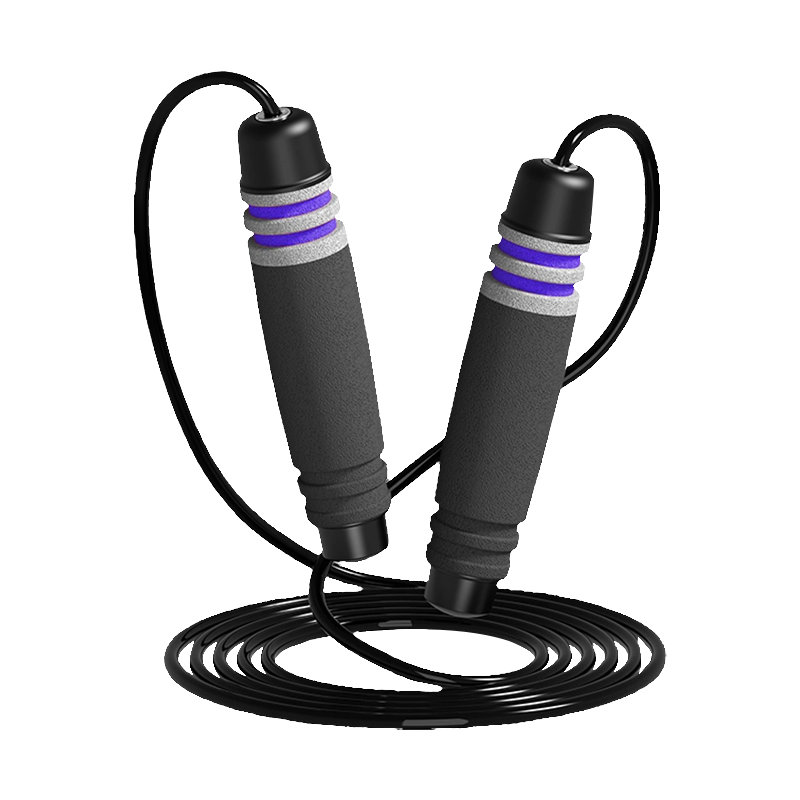
TS-3 Single Head Color/7 Groove Drum Shape Sponge Handle Jump Rope For Adults
News
-
Introduction to Racing Jump Ropes The humble jump rope, once a staple of playground nostalgia and simple cardiovascular warm-ups, has undergone a radical transformation in the mode...
READ MORE -
Discover the Power of Racing Jump Ropes Racing Jump Ropes: Defining the Speed Tool Racing Jump Ropes, often referred to as Speed Ropes, are high-performance fitness tools specifica...
READ MORE -
Introduction Jump rope workouts have long been a staple in fitness routines due to their simplicity and effectiveness. However, with the advent of technology, counting jump ropes h...
READ MORE -
Understanding the Benefits of Rubber Handle Jump Rope for Different Fitness Levels Jump rope is a simple yet highly effective fitness tool that has been gaining popularity in both ...
READ MORE

Contact Us
-

No. 215, Lane 4, Qiaotou Road, Qiaotou Town, Cixi City, Ningbo, Zhejiang Province, China.
-

+86-13867815229
-

Copyright © Cixi Lingdong Electronic Technology Co., Ltd. ALL rights reserved

UP